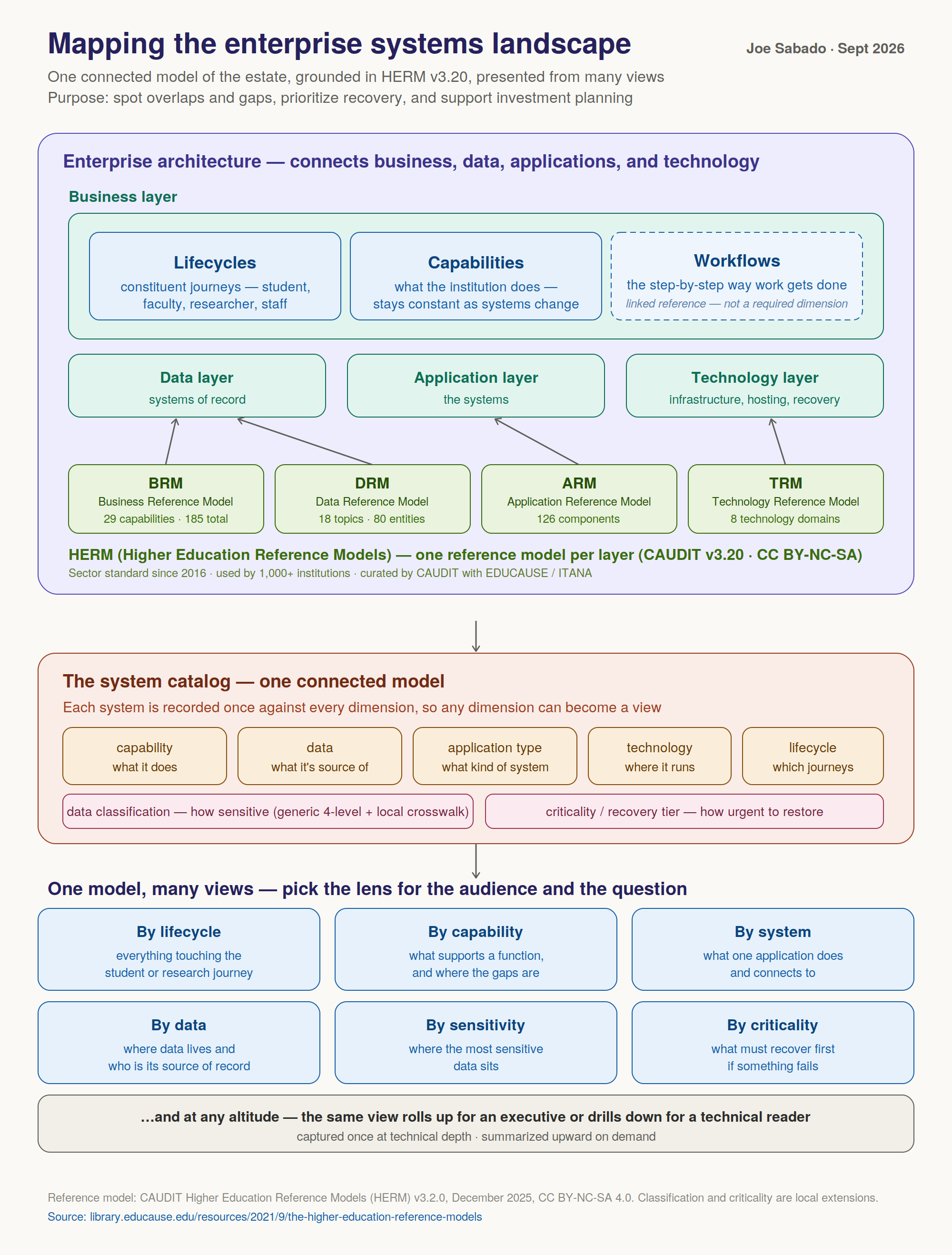
The higher ed enterprise model
One connected model of the estate, grounded in the Higher Education Reference Models.
Record each system once, against every dimension. Then any dimension becomes a view — to find overlaps and gaps, set recovery priorities, and guide investment.
Tip: click any box in the model below for details.
It shows how systems, capabilities, and data can be organized — not any one campus. Systems shown are examples. Real implementation varies by each campus's resources, priorities, and policies. Adapt it; don't copy it.
The site is deep — but you only need four stops to get the idea. Follow these in order, then explore the rest from the Contents menu.
What the major vendors' systems do, function by function, and the HERM capabilities each one supports. Explore each on an interactive wheel, or compare all four to see where they overlap.
No one owns the whole picture
The estate grew one system at a time. The questions that matter cross every boundary — which systems overlap, where sensitive data sits, what breaks if one fails — but the answers live in scattered spreadsheets and a few people's heads.
The same fact differs across a dozen systems, so no answer is trusted.
Products quietly duplicate each other; some capabilities have no owner at all.
Where sensitive data sits, and what must recover first, surface only in an audit or outage.
Record every system once, on one shared model. Then any question — overlap, gap, sensitivity, recovery — is answered in minutes, not months.
Enterprise architecture connects business, data, applications, and technology
Each system is recorded once against every dimension, so any dimension can become a view.
One model, many views
Pick the lens for the question. Every view rolls up for an executive or drills down to detail — captured once, summarized on demand.